Research published in the British Journal of Sports Medicine reveals a sobering truth: sedentary behavior is a distinct metabolic risk factor, independent of how much time you spend at the gym. This is known as the “Active Couch Potato” syndrome.
The Science: The LPL Shutdown
The primary driver behind the desk-job paradox is an enzyme called Lipoprotein Lipase (LPL). LPL is responsible for capturing fats from your bloodstream to be used as fuel. When you sit for prolonged periods, LPL activity in your leg muscles drops by as much as 90%. This leads to a cascade of metabolic issues: decreased HDL (good cholesterol), increased triglycerides, and impaired insulin sensitivity.
The 2-Minute Reset Protocol
To keep your metabolic “pilot light” on, you must disrupt the LPL shutdown.
1. The 30/2 Rule: Every 30 minutes, stand or move for 2 minutes. This isn’t about burning calories; it’s about signaling your muscles to re-activate LPL.
2. NEAT Optimization: Non-Exercise Activity Thermogenesis (NEAT) accounts for a larger portion of your TDEE than planned exercise. Simple habits like pacing during calls can add 200–400 calories to your daily burn.
3. Calorie Precision: If you work a desk job, your TDEE is often 15% lower than standard “Moderately Active” estimates. Use the [TDEE Calculator](/tdee-calculator/) to set a realistic baseline.
Discover the paradox of desk job success: how advancing your career causes physical decline. Learn actionable ergonomic and health strategies for professionals.
Modern professional environments demand intense, stationary focus for extended hours. This dynamic creates a severe evolutionary mismatch for the human body. The biological systems designed for constant movement are forced into sustained dormancy.
The paradox of desk job success occurs when professionals achieve immense career advancement through prolonged stationary work, while simultaneously triggering severe metabolic, structural, and cardiovascular decline. This dynamic forces individuals to unknowingly trade their physical deterioration for corporate upward mobility.
This contradiction requires a deep understanding of human physiology to overcome. Knowledge workers often seek treatment for isolated pain without addressing the root cause. This report dissects the specific mechanisms of this physical decline.
Professionals can successfully navigate this challenge without sacrificing their career trajectories. By implementing targeted strategies, you can reclaim your physical vitality.
The Hidden Toll: Spine, Muscles, and Metabolism
Prolonged sitting initiates a cascading failure across multiple biological systems. The structural and metabolic consequences compound silently over years of stationary labor. The human body rapidly adapts to the positions it occupies most frequently.
Unfortunately, adapting to a chair results in pathological changes to muscle tissue. These adaptations ultimately manifest as chronic pain and systemic disease. To understand these sedentary lifestyle health risks, we must examine the body’s internal mechanics.
Structural Deterioration and Gluteal Amnesia
The seated posture places the human body in a state of constant hip flexion. Sitting keeps the hips bent at a ninety-degree angle for hours at a time. This sustained position forces the hip flexor muscles to remain chronically shortened.
Over time, these shortened hip flexors become excessively tight and overactive. The gluteal muscles experience the exact opposite effect. Because the glutes are rarely called upon while seated, they physically lengthen and weaken.
This dynamic triggers a neurological process called reciprocal inhibition. The tight hip flexors send continuous signals to the central nervous system. These signals instruct the brain to neurologically “turn off” the opposing gluteal muscles.
In the medical community, this phenomenon is diagnosed as gluteal amnesia. It is also colloquially referred to as “Dead Butt Syndrome.” The gluteal muscles effectively become unresponsive, even when the individual eventually stands up.
The consequences of gluteal amnesia extend throughout the entire movement system. When these primary power generators remain offline, vulnerable muscle groups must absorb the mechanical load.
Compensatory Pain Patterns:
- Lower Back Strain: The lumbar spine muscles overwork to stabilize the pelvis.
- Hamstring Overuse: The hamstrings attempt to drive hip extension, leading to chronic strains.
- Knee Joint Pain: Weak glutes fail to align the femur, causing improper knee tracking.
- Hip Bursitis: Misaligned joint mechanics create debilitating friction within the hip capsule.
Research confirms a direct association between passive hip extension deficits and prolonged sitting. Individuals demonstrating high physical activity but prolonged sitting still display altered muscle properties. A brief gym session cannot fully reverse eight hours of static hip flexion.
Spinal Compression Dynamics
The lumbar spine bears the brunt of gravitational forces during seated work. Occupational sitting radically alters the distribution of pressure within the intervertebral discs. To understand sitting vs standing, we must analyze intradiscal pressure measurements.
Pioneering research established foundational data on spinal loading. Modern biomechanical analyses present a more nuanced understanding of this pressure. In structurally normal discs, sitting does induce significantly higher pressure than standing.
However, studies involving degenerated discs reveal no significant pressure differences between the two postures. The primary danger actually arises from the angle of back flexion while seated.
Lumbar Load Across Different Postures:
- Relaxed Standing: Moderate Risk
- Erect Sitting (Supported): Moderate Risk
- Slumped/Unsupported Sitting: High Risk
- Sitting with Forward Flexion: Severe Risk
Advanced simulations demonstrate how specific geometries impact the spine. Erect sitting on a chair produces pressure distributions remarkably similar to upright standing. Conversely, slumped sitting drastically changes the biomechanical equation.
Slouching extensively increases the pressure on the nucleus pulposus and the annulus fibrosus. This postural collapse removes the natural lumbar lordosis. It shifts the upper body weight entirely onto the fragile anterior disc structures.
Metabolic Stagnation and Insulin Resistance
The consequences of stationary work extend deep into cellular metabolism. Prolonged sitting acts as a potent catalyst for systemic metabolic dysfunction. The primary casualty of this inactivity is skeletal muscle insulin sensitivity.
When professionals sit for hours, this massive metabolic engine shifts into an idle state. The cellular mechanisms responsible for absorbing sugar from the bloodstream begin to shut down. This dysfunction centers on an intracellular protein known as GLUT4.
GLUT4 is the designated transporter that facilitates glucose uptake into the muscle cell. Under normal resting conditions, these transporters remain trapped deep inside the cell. To clear glucose from the blood, GLUT4 must physically travel to the cell’s outer plasma membrane.
The Dual Pathways of Glucose Transport:
- The Insulin Pathway: Insulin binds to cellular receptors, activating a complex signaling cascade.
- The Contraction Pathway: Physical movement provides an entirely separate, non-insulin-mediated stimulus.
Prolonged sitting severely compromises the insulin-mediated pathway. When muscles remain inactive, they develop a profound resistance to insulin signals. This state of sustained hyperinsulinemia accelerates the progression toward Type 2 diabetes.
However, muscle contraction offers a powerful physiological bypass. Physical movement activates an enzyme called 5′-AMP-activated protein kinase (AMPK). AMPK senses energy demands and immediately signals GLUT4 vesicles to translocate, completely bypassing broken insulin receptors.
The Mental Component: Stagnation, Cognitive Fatigue, and Stress
The physical toll of stationary work represents only half of the occupational hazard. Physical stagnation directly fuels psychological deterioration and cognitive decline. Human biology does not compartmentalize physical movement and brain function.
Experts identify this complex relationship as the sedentary-cognitive paradox. Contemporary work demands continuous, high-level cognitive output from employees. Concurrently, these environments practically eliminate the opportunity for physical movement.
The Mechanics of Cognitive Fatigue
Cognitive fatigue is a measurable deterioration in the brain’s ability to process information. Prolonged mental activity without physical interruption severely depletes neurological resources. This depletion manifests as a rapid decline in executive function and emotional resilience.
Individuals experience sudden forgetfulness and find it difficult to recall standard information. Complex problem-solving capabilities vanish, leaving workers paralyzed by routine decisions.
Aerobic movement is a primary biological driver of neuroplasticity. Physical activity stimulates the brain’s innate ability to repair and rewire its neural circuits. When professionals sit for endless hours, they halt this critical neurological maintenance.
Movement also regulates the release of essential neurotransmitters. Dopamine, serotonin, and endorphins require physical exertion to maintain optimal balances. The absence of movement leaves the brain chemically ill-equipped to handle high-stress workloads.
Break Guilt and Psychological Boundaries
Mitigating cognitive fatigue requires frequent, high-quality work breaks. Unfortunately, corporate culture frequently stigmatizes resting during operational hours. Many professionals experience profound guilt when stepping away from their desks.
This break guilt is a destructive psychological phenomenon documented in high-pressure environments. Organizations often signal that relentless availability equates to dedication and value. Consequently, employees view legally mandated recovery time as a professional liability.
When professionals do take a break, they often experience shame. This shame triggers severe reputational concerns upon returning to the workstation. Employees will spend subsequent hours attempting to mask their absence by feigning intense productivity.
The Psychological Hurdles to Recovery:
- Decision Fatigue: Continuous professional choices drain the brain’s executive functioning. Skipping breaks prevents the mind from refueling, leading to disastrous analytical errors.
- Social Proof: Workplace behavior is highly contagious. If colleagues refuse to take breaks, individuals feel intense pressure to conform.
Stepping away requires overcoming profound structural conditioning. Professionals must recognize that strategic detachment improves memory consolidation and prevents memory saturation. True recovery demands a complete shift in cognitive and physical context.
Breaking the Paradox: 4 Actionable Habits
Surviving a knowledge-based profession requires treating physical health as a non-negotiable metric. The human body requires highly deliberate interventions to withstand office environments. These interventions must be seamless, practical, and scientifically validated.
The goal is not to eliminate sitting entirely, as standing indefinitely introduces new pathologies. The objective is to engineer a dynamic environment that forces continuous positional variation. By implementing precise rules, professionals can neutralize the paradox of the desk job.
Habit 1: The Ergonomic Desk Setup
The physical geometry of your workstation dictates the resting state of your musculoskeletal system. Poor alignment forces muscles into constant, low-level isometric contractions just to keep the head upright. A proper ergonomic desk setup eliminates these invisible physical stressors.
Investing in a height-adjustable active workstation is the foundational step. However, the body must remain in a neutral, supported posture regardless of the desk’s height.
Scientific Guidelines for Workstation Geometry:
- Monitor Alignment: Position the top third of the screen precisely at eye level. Angle the monitor upward by ten to twenty degrees.
- Focal Distance: Ensure the screen remains roughly an arm’s length away.
- Arm Kinetics: Adjust the desk height so elbows rest at a ninety-degree angle. Wrists must remain flat and neutral with minimal bending.
- Spinal Support: Your chair must feature dedicated lumbar support to maintain natural curvature. Keep the upper back straight or slightly reclined against the backrest.
- Lower Body Foundation: Feet must rest entirely flat on the floor. If the desk is too high, utilize a sturdy footrest to achieve parallel thigh alignment.
Professionals must diligently avoid contact stress. Resting wrists against sharp desk edges compresses superficial nerves, leading to carpal tunnel syndrome.
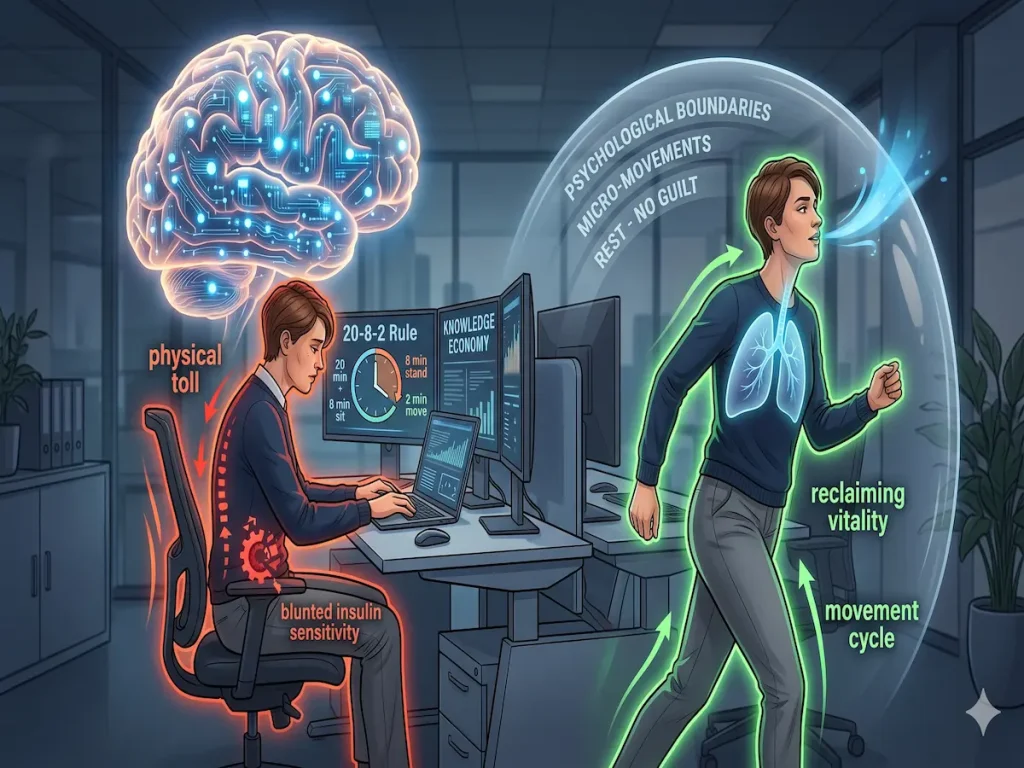
Habit 2: The 20-8-2 Movement Rule
Behavioral compliance is the most difficult aspect of workplace health. Many professionals purchase expensive standing desks only to leave them seated permanently. Overcoming this inertia requires a structured, easily repeatable rhythm.
Professor Alan Hedge at Cornell University developed the definitive framework for positional rotation. His evidence-based heuristic ensures the body rarely remains in a static load state. This globally recognized protocol is known as the 20-8-2 rule.
The framework divides every thirty-minute block of the workday into three distinct behavioral phases. It provides a perfect balance between deep cognitive focus and physical health at work.
The 20-8-2 Protocol Breakdown:
- Sit for 20 Minutes: Utilize your ergonomic chair to perform intensive, focused tasks. This duration prevents the adverse metabolic effects of prolonged sitting without inducing fatigue.
- Stand for 8 Minutes: Transition the active workstation to a standing height. This posture change immediately re-engages dormant gluteal muscles and alters lumbar disc load.
- Move for 2 Minutes: Step completely away from the workstation for light physical activity. This critical phase resets the musculoskeletal system and floods the brain with oxygenated blood.
The final two minutes of movement are the most vital component of the entire rule. Alternating between sitting and standing increases energy expenditure by a modest twenty percent. However, active movement drives massive cardiovascular and metabolic benefits that posture changes alone cannot match.
Cornell University demonstrated that adhering to this specific rhythm yielded zero impairments to cognitive performance. Attention spans and short-term memory capacity remained fully intact. Utilize smartwatch alarms or browser extensions to ensure strict adherence to this protocol.
Habit 3: Non-Disruptive Desk Exercises
The modern professional frequently encounters scenarios where leaving the desk is impossible. Back-to-back virtual meetings often trap workers in their chairs. In these moments, desk exercises serve as vital physiological lifelines.
Micro-movements are discrete, isolated physical actions designed to be performed directly at the workstation. They require zero specialized equipment and can often be executed off-camera. These brief stretches powerfully interrupt the neurological signals that cause muscle amnesia.
Essential Desk-Friendly Movements:
- The Lateral Weight Shift: While standing, gently shift body weight from the left foot to the right foot every few minutes. This prevents the knees from locking and alternates stress on the hip capsules.
- Seated Spinal Twists: Sit tall and place your right hand onto your left knee. Gently rotate your torso toward the left, holding the stretch for ten seconds to decompress the lumbar spine.
- Gluteal Squeezes: While seated, consciously contract the gluteus maximus muscles tightly for several seconds. This targeted isolation exercise forcibly reminds the brain to reconnect with the posterior chain.
- Desk Chest Openers: Place both hands flat against the edge of the desk. Gently press down while lifting your chest upward and pulling your shoulders back to combat hunched posture.
- Ankle Rotations: Lift one foot slightly off the floor while seated and slowly rotate the ankle in wide circles. This movement acts as a mechanical pump, dramatically boosting lower body circulation.
Consistently executing these movements throughout the day provides cumulative relief. They prevent the fascia from stiffening and keep joint fluid active.
Habit 4: The Psychological Shutdown Ritual
Physical optimization addresses only the biomechanical aspect of the desk job paradox. Remote and hybrid work environments have erased the natural geographic boundaries between the office and the home. This spatial blurring prevents the brain from ever fully downregulating stress hormones.
Without a physical commute, remote professionals require deliberate psychological boundaries. The most effective behavioral intervention for achieving this separation is a strict shutdown ritual.
A shutdown ritual is a disciplined sequence of mechanical steps executed at the exact conclusion of the workday. This practice creates a tangible, psychological dividing line. It acts as a definitive signal to the nervous system that professional obligations are suspended.
The Anatomy of a Shutdown Ritual:
- Total Loop Closure: Review all digital inboxes, meeting notes, and communication channels. Every incomplete task must be captured and documented within a trusted external system.
- Next-Day Prioritization: Briefly outline the most critical steps required for the following morning. Planning ahead severely reduces morning friction and releases anxiety regarding future workloads.
- Workspace Sterilization: Cleaning the physical or digital desk provides the brain with time to analyze the day’s events. Closing browser tabs serves as a powerful visual cue that work is finished.
- The Transition Activity: Conclude with a deliberate physical action that breaks the context of work. This could involve an intense home workout or walking the dog to reset your physiology.
By storing obligations in a reliable system, you prevent your subconscious from ruminating during evening hours. This cognitive detachment is a clinical necessity for preventing burnout.
Conclusion
The modern knowledge economy exacts a steep physical toll on the human body. The desk job paradox forces you to navigate an environment that rewards intellectual output while dismantling musculoskeletal health. Acknowledging this fundamental mismatch is the first step toward reclaiming your vitality.
Prolonged sitting rewires neuromuscular pathways, compresses intervertebral discs, and aggressively blunts cellular insulin sensitivity. Simultaneously, this physical immobility starves the brain of the neurochemical fuel required to sustain high-level cognitive performance.
Overcoming this paradigm requires disciplined, scientifically validated interventions. Construct ergonomic environments that support neutral physical architecture. Adhere strictly to positional rotation frameworks like the 20-8-2 rule.
Establish impenetrable psychological boundaries to protect your mind from chronic stress. Integrate consistent micro-movements and reject the guilt associated with rest. Stand up right now, take a deep breath, and begin your next movement cycle.
**Reference:** *Hamilton, M. T., et al. (2007). Role of Low Energy Expenditure and Sitting in Type 2 Diabetes and Obesity. Diabetes.*