Back to articles
willpower vs system

Systems vs. Willpower

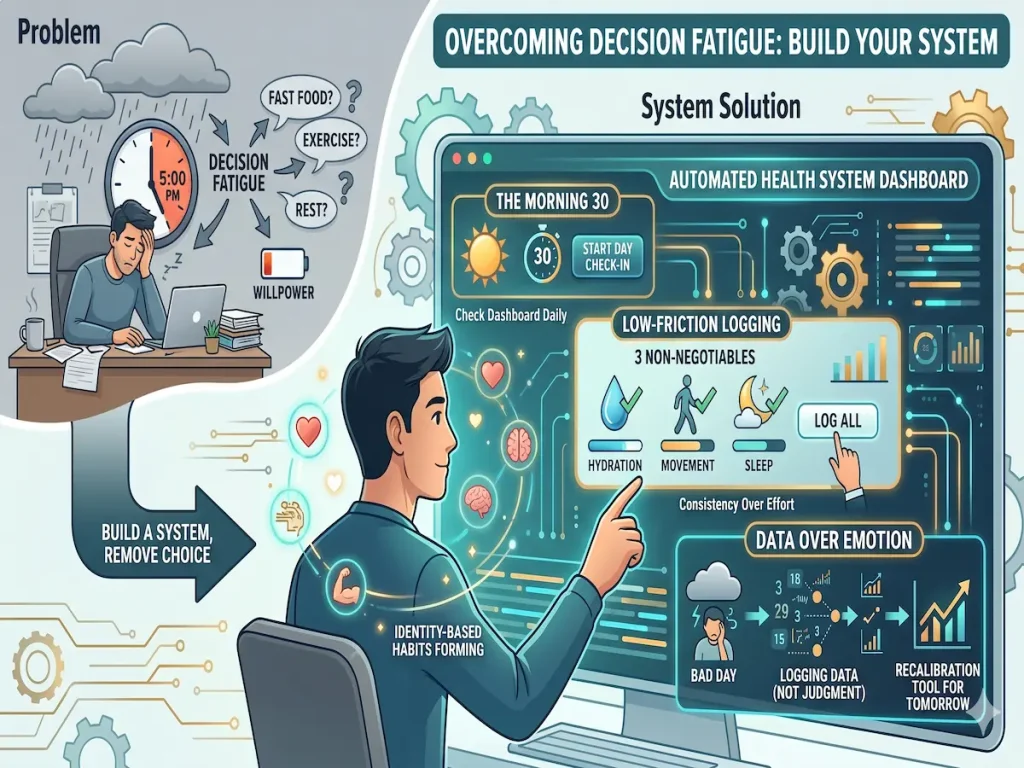
Willpower is an exhaustible resource. Decision fatigue is why most people make poor health choices after 5:00 PM. The solution is not “trying harder”—it is building a system that removes the need for choice.

The Psychology of Small Wins
Research on habit formation shows that “identity-based habits” are more durable than “outcome-based” ones. When you track a metric, you begin to identify as someone who cares about that metric.

The Automated Health System
1. The Morning 30: Spend 30 seconds every morning checking your [Health Planner Dashboard](/dashboard/).
2. Low-Friction Logging: Use the tracker to log just your 3 non-negotiables. Consistency is the primary variable for metabolic change.
3. Data over Emotion: When you have a bad day, log it. The data isn’t a judgment; it’s a recalibration tool for tomorrow.

 The Epistemological Collapse of Willpower

For the better part of a century, the prevailing paradigm in health behavior change has been predicated on a profound misunderstanding of human cognition. This paradigm, heavily reliant on the concept of willpower, operates on the assumption that individuals can reliably overcome deeply ingrained habits, biological imperatives, and environmental temptations through sheer conscious effort. When individuals fail to maintain a diet, skip a workout, or succumb to late-night snacking, the traditional diagnostic conclusion is a lack of moral fortitude or discipline. The prescribed solution is almost universally to “try harder.”

This paradigm is fundamentally flawed and empirically bankrupt. Relying on motivation and brute-force self-control to achieve long-term metabolic or physical transformations routinely results in systemic behavioral relapse. The assumption that individuals make poor dietary or exercise choices after 5:00 PM simply because they are not trying hard enough ignores the complex cognitive, neurological, and computational realities of the human brain. The human executive function is not an indomitable force; it is a highly volatile, strictly limited processing system that degrades predictably under continuous load.

Recent advancements in behavioral science, cybernetics, neuroeconomics, and organizational psychology demonstrate that sustainable behavior change requires a radical departure from effort-centric models. The solution to chronic health failure is not the cultivation of greater willpower, but rather the construction of a low-friction behavioral architecture. By transitioning from a motivation-centric model to a systems-centric model, individuals can bypass conscious choice entirely. This approach relies on identity-based habit formation, pre-commitment strategies, and cybernetic feedback loops to automate behavior, transforming health from a series of exhausting daily battles into an effortless, self-sustaining system.

The Cognitive Mechanics of Willpower and the Ego Depletion Debate

The Strength Model of Self-Control

The modern understanding of willpower was heavily shaped by the “strength model of self-control,” a theoretical framework popularized by Roy Baumeister and his colleagues in the mid-1990s.1 This model posits that self-control draws upon a limited, exhaustible internal metabolic or psychological resource, functioning much like a muscle that fatigues with sustained use.3 According to this theory, engaging in tasks that require the overriding of dominant responses—such as emotional suppression, complex problem-solving, impulse control, or resisting temptation—consumes this psychological fuel, leading to a state termed “ego depletion”.1

In a state of ego depletion, subsequent attempts at self-regulation are severely impaired, even if the secondary task is entirely unrelated to the first.3 The basic experimental structure utilized to prove this phenomenon involved participants performing a willpower-dependent task, such as the Stroop task or an antisaccade task, followed by a secondary task.1 Experiments repeatedly reported that ego depletion not only led to decreased performance in tasks requiring willpower but also negatively impacted decision-making, rational thinking, planning ability, and other activities heavily associated with executive function.1 Over 600 studies appeared to support the veracity of ego depletion, cementing it as a foundational concept in experimental and social psychology, and embedding the idea of exhaustible willpower into the cultural zeitgeist.4

The Replication Crisis and Theoretical Evolution

Despite its widespread acceptance and apparent empirical robustness, the strength model of self-control has recently become the central focal point of psychology’s broader “replication crisis”.1 As researchers attempted to validate the precise physiological and cognitive mechanisms behind ego depletion—specifically looking for the biological substrate of this alleged “fuel”—the empirical foundation of the theory began to fracture. Most notably, a pre-registered, 23-laboratory replication study conducted by Martin Hagger and Nikos Chatzisrantis—researchers who had previously authored a highly cited meta-analysis supporting ego depletion—failed to find a significant ego-depletion effect.3

This systemic failure to replicate foundational findings forced a critical reevaluation of how cognitive fatigue actually operates.5 If willpower is not a literal, depletable metabolic resource, researchers were forced to identify why individuals still consistently experience the phenomenology of mental fatigue and exhibit predictable subsequent self-control failures. Consequently, the field shifted away from biologically improbable “resource” metaphors and toward more precise mechanistic, motivational, and computational models of human cognition.4

Neuroeconomics and the Computational Limits of Self-Control

The erosion of the strength model gave rise to two primary alternative frameworks that better explain the mechanics of self-control failure without relying on the concept of an exhaustible fuel: the Process Model of Self-Control and the Opportunity Cost Model. These models provide the necessary theoretical architecture to understand why choice itself is the enemy of sustainable health.

The Process Model of Self-Control

Michael Inzlicht and Brandon Schmeichel introduced the Process Model of Self-Control, which argues that initial exertions of self-control do not drain a physical resource, but rather trigger systematic, temporary shifts in both motivation and attention.4 According to this model, after a period of cognitive exertion, an individual’s motivation shifts away from “have-to” goals—such as adhering to a strict diet, completing a difficult project, or exercising—and toward “want-to” goals, such as consuming palatable food, resting, or seeking immediate gratification.4

This motivational pivot is inextricably linked to an attentional shift.4 As an individual exerts cognitive effort throughout the day, their neurological salience networks become highly attuned to cues of reward and gratification while simultaneously beginning to ignore cues related to long-term goals.7 Therefore, the individual who abandons their diet in the evening has not “run out of willpower”; rather, their brain has dynamically shifted its processing priorities, hyper-focusing on the immediate reward of food while dampening the cognitive resonance of long-term health objectives.

The Opportunity Cost Model of Mental Effort

Operating in tandem with the Process Model is the Opportunity Cost Model of mental effort, a framework rooted in neuroeconomics and evolutionary psychology proposed by Robert Kurzban and colleagues.11 This model posits that the brain operates as an advanced information-processing system with strictly limited computational bandwidth. Certain computational mechanisms, particularly those associated with executive function and working memory, can only be deployed for a limited number of simultaneous tasks at any given moment.12

As a person engages in effortful control, the brain continuously and automatically computes the “opportunity cost” of this engagement—namely, the value of the next-best alternative task that could be executed with those same limited cognitive resources.11 The subjective feeling of mental fatigue or “ego depletion” is not a physiological alarm signaling empty fuel reserves, but rather the felt output of this complex cost-benefit computation.12 It is an adaptive, evolutionary mechanism designed to signal the organism to stop deploying cognitive systems toward the present task because alternative actions—such as resting or consuming calories—are now deemed more valuable.12

Theoretical ModelPrimary Mechanism of Self-Control FailureParadigm Implication for Health Behavior
Strength Model (Ego Depletion)Exhaustion of a finite metabolic or psychological resource.Individuals must carefully conserve their limited willpower throughout the day to survive evening choices.
Process Model of Self-ControlUnconscious shifts in attention and motivation toward immediate gratification and away from control.Health systems must be designed to not rely on attention or motivation, as both will inevitably shift.
Opportunity Cost ModelNeuroeconomic cost-benefit algorithms determining that executive function bandwidth is better spent elsewhere.Health behaviors must be engineered to require zero computational bandwidth, bypassing opportunity cost calculations entirely.

Decision Fatigue and the Anatomy of the 5:00 PM Metabolic Collapse

The computational limitations outlined by the Opportunity Cost Model provide the precise neurological mechanism behind “decision fatigue”—the observable deterioration in decision quality following a long, sustained session of cognitive processing.16 Everyday eating behavior is exceptionally cognitively demanding, far more so than most individuals realize. The average individual is forced to make over 221 food-related decisions every single day.18

The Cognitive Burden of Dietary Choice

These 221 decisions are not simple binary choices. They require multifactorial trade-offs, forcing individuals to continuously weigh complex, competing variables such as taste, health, cost, convenience, ethical considerations, and preparation time.17 Furthermore, individuals must navigate these choices within modern food environments—such as supermarkets or delivery applications—that are highly engineered with endless products, promotions, and nudges competing for their attention.17

This relentless sequence of decision-making creates a massive, compounding cognitive load.17 By 5:00 PM, after a full day of occupational problem-solving, emotional regulation, and micro-choices, an individual’s executive function bandwidth is heavily constrained. According to the dual-process theory of cognition, food choices are guided by two distinct pathways: the reflective pathway, which is deliberate, analytical, and effortful; and the automatic pathway, which is fast, unconscious, cue-responsive, and effortless.17

When cognitive resources are intact early in the day, individuals are capable of utilizing reflective thinking to make health-conscious choices.17 However, as the Opportunity Cost Model predicts, when decision fatigue sets in, the brain calculates that the cost of executing a complex, reflective meal plan is too high. To conserve computational energy, the brain forcefully shifts behavior toward the automatic pathway.17 Fatigued individuals inevitably default to energy-dense, highly palatable, or convenient foods—even if they possess a strong, genuine underlying motivation to eat healthily.17

Vulnerable Populations and the Statistics of Failure

This phenomenon explains the systemic nature of dietary failure. Survey data reveals that 90% of individuals begin the week eating healthy, but by Friday, over 33% have fallen completely off track due to the cumulative toll of decision fatigue.18 Furthermore, nearly a quarter of individuals routinely rely on expensive, unhealthy takeaways, an automatic choice that adds an estimated ÂŁ412 annually to their food budgets.18

Vulnerability to cognitive and decision fatigue is not distributed evenly across the population. Self-regulatory depletion is significantly more pronounced among individuals experiencing chronic stress, socioeconomic disadvantage, and high daily decision loads.17 Shift workers, caregivers, and low-income households managing constrained resources operate with a baseline of high cognitive strain, making them exceptionally susceptible to impulse-driven food choices.17 For these populations, convenience foods act as an essential self-regulatory escape strategy, used as a tool to bypass the demanding cognitive load of cooking and meal planning in the evening.17 Therefore, overcoming 5:00 PM decision fatigue is not a matter of exerting more willpower, but of recognizing the biological limits of the brain and removing the requirement for evening decision-making entirely.

Behavioral Architecture and Choice Systematization

To circumvent the inherent vulnerabilities of executive function and the inevitability of decision fatigue, behavior change must be entirely outsourced to the environment. This is achieved through behavioral architecture—the strategic design of environments, cues, and choice systems to automate desired outcomes and eliminate the need for conscious, in-the-moment decision-making.

The Fogg Behavior Model (B=MAP)

Stanford behavioral scientist BJ Fogg posits that human behavior is not an unpredictable phenomenon driven by willpower or moral fortitude, but a predictable outcome governed by an exact, non-judgmental formula: B = MAP.19 This model dictates that Behavior (B) only happens when Motivation (M), Ability (A), and a Prompt (P) converge at the exact same moment.19 If an individual fails to execute a health behavior, it is because at least one of these three variables is missing or insufficient.20

While traditional health paradigms over-index on Motivation—which, as the Process Model of Self-Control demonstrates, is highly volatile and guaranteed to shift under fatigue—the Fogg Behavior Model emphasizes the aggressive manipulation of Ability and Prompts.19 Ability, in this framework, is defined not by physical competence, but by simplicity: how easy and frictionless it is to perform the target action.20 Fogg outlines six specific factors that determine this simplicity: Time (how long it takes), Money (what it costs), Physical effort (exertion required), Mental effort (cognitive load), Social deviance (conflict with norms), and Non-routine (familiarity).20

By radically scaling down the desired behavior, an individual actively removes all friction, rendering motivation effectively irrelevant.19 For instance, reducing the goal of “running 3 miles” to “putting on running shoes and stepping outside,” or reducing “meditating for 20 minutes” to “taking one deep breath,” forces the action into the realm of absolute high Ability.19 When the action is laughably small, the mental effort approaches zero, effectively bypassing the brain’s opportunity cost calculations and nullifying decision fatigue.

Pre-commitment and Choice Architecture

A robust behavioral system also relies heavily on “choice architecture” and “pre-commitment” strategies.22 Pre-commitment is a behavioral strategy wherein an individual makes a choice in the present that deliberately limits, restricts, or heavily structures their options in the future.22 Because humans are evolutionarily predisposed to procrastination, loss aversion, and discounting future rewards in favor of immediate gratification, relying on in-the-moment decision-making is a guaranteed vector for failure.22

By pre-committing, an individual acknowledges their future vulnerability to decision fatigue and preemptively removes the option to fail.22 Examples include purchasing non-refundable fitness memberships, scheduling precise days and times to train with an accountability partner, or batch-preparing meals on Sunday to completely eliminate the need to make food choices on Wednesday evening.22 Research demonstrates that when choice architecture forces a pre-commitment, follow-through on health and financial goals increases exponentially, as it shifts the penalty of failure from mere internal disappointment to tangible financial loss, social cost, or severe cognitive dissonance.24 Survey data supports this, showing that 78% of respondents who are at their goal weight actively plan their meals, with 70% of those attributing their healthier choices entirely to this preparation and pre-commitment.18

Implementation Intentions and Gollwitzer’s If-Then Planning

A specific, highly potent, and neurologically efficient form of pre-commitment is the formulation of “implementation intentions,” a concept developed by psychologist Peter Gollwitzer.26 While a standard goal intention specifies a desired outcome (e.g., “I intend to eat healthier”), an implementation intention specifies the exact behavioral response to a specific situational cue using an explicit “if-then” format (e.g., “If it is 5:00 PM and I am leaving the office, then I will eat the pre-packed apple in my bag”).26

Implementation intentions operate by delegating the control of goal-directed responses away from conscious willpower and directly to environmental cues.26 Through the deliberate mental act of linking an anticipated critical situation with an effective response, the individual creates a hardwired cognitive association.28 When the “if” situation arises in the real world, the “then” behavior is triggered automatically and without conscious deliberation.28 This is particularly effective for behavior modification in domains with significant immediate costs and long-term rewards, such as nutritious dieting and attending medical screenings.27 Meta-analyses have shown that if-then planning dramatically enhances goal attainment by resolving the exact self-regulatory problems that typically beset goal striving during periods of ego depletion.26

Pre-commitment StrategyMechanism of ActionPractical Application in Health Architecture
Choice RestrictionEliminates alternative options to force compliance.Removing all junk food from the house; meal-prepping on Sundays.
Financial/Social BindingIncreases the immediate cost of failure to outweigh the effort of the task.Hiring a trainer; publicly committing to a race; non-refundable classes.
Implementation Intentions“If-Then” planning delegates behavior to environmental cues, bypassing executive function.“If my alarm rings, then I will immediately put on my gym clothes.”

The Psychology of Small Wins and Incrementalism

When attempting to design a behavioral system or overhaul a lifestyle, individuals frequently define problems in ways that overwhelm their cognitive ability to solve them.31 Setting massive, outcome-oriented goals—such as losing 50 pounds or radically altering a diet overnight—triggers profound psychological roadblocks, inducing paralysis, self-doubt, and the activation of the brain’s threat-response systems.32 To counteract this, sustainable systems must be built entirely upon the psychology of “small wins,” a theoretical framework pioneered by organizational psychologist Karl Weick.31

Karl Weick’s Framework of Non-Linear Change

Weick’s perspective replaces linear, sweeping policy-development approaches with non-linear, complex systems thinking and incrementalism.33 A small win is defined as a concrete, complete, and implemented outcome of moderate importance.35 By deliberately scaling down the magnitude of the objective, small wins severely reduce the intimidation factor and build incremental confidence.32

More importantly, small wins fundamentally alter the psychological stakes of behavior change. Because the step is so minor, the costs of failure are negligible.31 This radically lowers internal resistance and emotional reactivity. As Weick famously noted, massive scale precludes innovative action, because people cannot solve problems if they define them in ways that overwhelm their capabilities.31 Small, opportunistic steps allow an individual to start with fewer preconceptions and bypass the need to analyze every variable before taking action, which is an inherently impossible task for complex, “wicked” problems like systemic metabolic health.31

Experimental Probes and the Bandwagon Effect

In Weick’s framework, small wins function dynamically as “experimental probes”.32 Complex behavioral domains—such as completely overhauling a sedentary lifestyle—are effectively black boxes without clear, inherent properties.35 Small wins act as miniature, low-risk experiments that test implicit theories about internal resistance, uncovering both hidden resources and invisible barriers that were previously obscured.32

Furthermore, small wins capitalize on the psychological phenomenon known as the bandwagon effect.33 As micro-successes accumulate, they generate collective energy and internal momentum.32 Progress in this model is not necessarily moving linearly toward a grand idealized state; it is often simply moving away from bad conditions, which is far easier to measure and execute.35 When a series of small wins occur simultaneously over time, they coalesce into an infectious pattern of continuous change, ultimately transforming into a broader movement of transformative personal architecture that is incredibly difficult to stop.33

Identity-Based Habits and the Reversal of Motivation

The ultimate, overarching objective of any automated health system is to shift a behavior from something an individual does to something an individual is. Habit formation researchers, most notably James Clear, argue that behavior change occurs across three concentric layers: outcomes, processes, and identity.36

Outcome-Based vs. Identity-Based Paradigms

The traditional approach to behavior change is almost exclusively “outcome-based”.37 Individuals focus primarily on what they want to achieve (e.g., losing 20 pounds, running a marathon, lowering blood pressure).37 They then develop rigid processes to reach those outcomes, operating under the assumption that achieving the result will ultimately change how they view themselves.36 This backward approach is highly susceptible to behavioral relapse because it relies on sustained effort without ever altering the fundamental self-image that drives long-term decision-making.36

The superior, scientifically validated alternative is the “identity-based” habit paradigm.36 This approach begins at the deepest layer of behavior change: focusing relentlessly on who the individual wishes to become.37 Because every action performed by a human being is driven by a fundamental, often unconscious belief about what is possible and congruent with their self-concept, changing identity makes changing actions exponentially easier.36 To initiate an identity shift, an individual must first decide the type of person they want to be, and then prove it to themselves through continuous, small wins.37 For example, instead of aiming to “read a book,” the goal becomes identifying as “a reader” and proving it by reading one paragraph daily.36 Each micro-behavior acts as a definitive vote for the new identity, gradually reshaping self-perception over time.38

Daryl Bem’s Self-Perception Theory

The empirical foundation for identity-based habits resides in Self-Perception Theory, introduced by social psychologist Daryl Bem in 1967.40 Traditional psychological models assume an inside-out progression: an individual’s attitudes, emotions, and motivation dictate their subsequent behavior.42 Bem’s theory radically inverted this assumption, positing an outside-in progression. Bem argued that people do not inherently know their own inner states; instead, they infer their attitudes, beliefs, and identities by observing their own behavior, much like an outside observer would.40

In the context of health behavior and lifestyle medicine, this means that a person does not act with focus and discipline because they inherently possess those traits; rather, they become a disciplined person by witnessing themselves act with focus again and again.42 Behavior precedes motivation.40 When an individual tracks a small metric, such as walking 50 steps after work, their brain observes this action with great curiosity and infers, “I must be the type of person who prioritizes physical activity”.37

If an individual’s actions conflict with their established self-perception, it generates cognitive dissonance—a state of intense psychological discomfort.24 To resolve this dissonance, the brain either alters the behavior or updates the belief.45 By utilizing identity-based habits, individuals leverage consistency bias; declaring oneself an athlete creates a psychological pressure to perform actions that align with that self-concept, actively mitigating the discomfort of dissonance.24 As identity and behavior mutually reinforce one another in a circular loop, the reliance on willpower completely vanishes, rendering the subject highly resistant to disruption even under severe cognitive load.39

Paradigm FocusCore QuestionProgression MechanismRelapse Vulnerability
Outcome-Based“What do I want to achieve?”Motivation dictates behavior, leading to results.Extremely High. Once the outcome is achieved or seems too far away, motivation collapses.
Identity-Based“Who do I wish to become?”Behavior dictates self-perception, updating identity.Extremely Low. The behavior becomes intrinsically linked to the individual’s sense of self.

The Cybernetics of Self-Regulation and the Feedback Loop

To effectively track these small wins and shape self-perception, a behavioral architecture must utilize rigorous data tracking. The most effective way to understand how tracking alters behavior is through the lens of Control Theory, a cybernetic framework applied to human psychology by Charles Carver and Michael Scheier.46

Control Theory models human self-regulation not as a matter of willpower, but as a mechanical, negative (discrepancy-reducing) feedback loop, directly analogous to a thermostat regulating room temperature.46 This feedback loop is composed of five specific, interacting sub-functions:

  1. Reference Value: The goal, standard, or identity that is currently guiding behavior (e.g., “I am someone who trains daily”).46
  2. Input Function: The perception of present circumstances; the individual observing their own behavior (e.g., tracking a completed workout).46
  3. Comparator: The psychological mechanism that compares the Input to the Reference Value.46
  4. Error Signal: The discrepancy detected between the current state and the goal.48
  5. Output Function: The behavioral adjustment initiated to reduce the discrepancy and realign with the reference value.46

When people move physically or psychologically toward their goals, they manifest the functions of this discrepancy-reducing loop.50 Every time an individual tracks a habit, logs a streak, or measures a metric, they are providing crucial data to the Input Function. This data feeds into the Comparator, which checks it against the Reference Value (their desired identity). If an Error Signal is detected (e.g., they missed a workout), the Output Function triggers an immediate behavioral correction to restore equilibrium.46 This cybernetic process occurs automatically, requiring very little conscious effort, provided the individual consistently tracks their inputs.

The “What the Hell” Effect and the Pathogenesis of Relapse

The greatest threat to this cybernetic feedback loop—and the primary cause of long-term health failure—is the injection of emotional judgment into the Comparator phase. When individuals allow shame and guilt to infect their data tracking, they trigger a deeply destructive cognitive pattern known as the “What the Hell” effect, identified by researchers Janet Polivy and C. Peter Herman.51

The Mechanics of Cascading Failure

The “what the hell” effect describes a highly specific sequence of cognitive write-offs: an individual makes a plan, breaks it via a minor slip-up, and instead of course-correcting at the next opportunity, experiences a sense of total failure and abandons the entire plan.51 In fitness and diet, this translates to a devastating spiral. An individual misses a Monday workout, decides to write off Tuesday, writes off the entire week, and eventually abandons the month, telling themselves they will simply start over next January.52

In landmark dietary studies, researchers demonstrated this effect by tricking “restrained eaters” (dieters) into thinking they had broken their diet, even though they actually had not.52 Those who merely believed they had broken their diet went on to consume far more food—specifically highly palatable foods like ice cream—than the participants who believed they were still on track.17 This proves conclusively that it is not the objective consumption of calories or the physiological failure that causes a binge; rather, it is the negative, shame-inducing narrative the individual tells themselves about the slip-up that drives the behavioral collapse.51

Self-Compassion and Muscle Memory as Recovery Tools

To combat the “what the hell” effect, researchers emphasize two critical interventions: self-compassion and the utilization of physiological realities like muscle memory.

When people fall off their plans, they default to harsh self-punishment, calling themselves weak or lazy.52 However, scientific evidence definitively shows that being harsh on oneself after a slip-up does not increase discipline; instead, it dramatically increases stress levels, raises the likelihood of procrastination, and makes another slip-up mathematically more probable.52 Individuals who practice self-compassion, treating themselves with the objective, non-judgmental kindness they would offer a friend, recover from setbacks exponentially faster.52

Furthermore, understanding physiological realities neutralizes the despair of a setback. Studies on muscle memory demonstrate that previously trained muscle rebuilds dramatically faster than it did the first time.52 Strength returns in weeks rather than months, meaning the foundation built in the past is never fully erased.52 The individual is never truly starting over from scratch; they are simply picking back up, which renders the “what the hell” spiral logically baseless.52

The Automated Health System: A Prescriptive Architecture

Synthesizing the neuroeconomics of decision fatigue, the behavioral architecture of B=MAP, the cognitive restructuring of Self-Perception Theory, and the cybernetic feedback loops of Control Theory yields a concrete, three-tiered framework for sustainable health behavior. This Automated Health System operates not by commanding the individual to “try harder,” but by systematically removing friction, limiting choice, and utilizing neutral, data-driven feedback loops.

Pillar 1: The Morning 30 (Anchoring via Dashboard Diagnostics)

The first pillar of the system is the “Morning 30″—the requirement to spend exactly 30 seconds every single morning checking a centralized Health Planner Dashboard. This functions as a micro-behavior anchored to a specific temporal prompt, perfectly adhering to the Fogg Behavior Model’s requirement for high Ability and a clear Trigger.19

By executing this action first thing in the morning, the individual establishes a critical pre-commitment before cognitive fatigue accumulates.22 The dashboard review sets the day’s implementation intentions, bringing the individual’s “if-then” plans to the forefront of consciousness while their executive function is fully recharged.28 Because it requires a mere 30 seconds, it bypasses the brain’s opportunity cost calculations, demanding effectively zero cognitive bandwidth.12 Yet, through the lens of Bem’s Self-Perception Theory, performing this action daily sends a powerful signal to the brain. The individual observes themselves checking a health dashboard before the day begins, and the brain infers, “I must be an organized, health-conscious person,” laying an unshakable psychological foundation for the rest of the day’s choices.39

Pillar 2: Low-Friction Logging and the Supremacy of Consistency

The second pillar requires the use of a tracker to log exactly three non-negotiable health behaviors daily. Crucially, the primary objective of this logging is not to measure the intensity, duration, or quality of the performance, but strictly to measure execution and attendance.

Behavioral science unequivocally demonstrates that the frequency of repetition is a vastly stronger predictor of automatic habit formation than the duration or effort of the activity.39 When individuals track performance metrics (e.g., speed, total weight lifted, calories burned), they inadvertently link their identity to outcomes, which will inevitably fluctuate based on daily energy levels and external stressors.39 Conversely, when they engage in low-friction logging focused purely on attendance and completion, they prioritize consistency.39

This low-friction tracking operates as a continuous stream of Weick’s small wins.32 A log of simply “showing up” serves as an experimental probe that circumvents intimidation and proves the new identity.32 The person who logs 5 minutes of stretching is observing themselves prioritizing health, thereby solidifying the identity of “someone who trains”.39 Consistency is the primary variable for true metabolic and psychological change, and low-friction logging engineers an environment where achieving that consistency is practically unavoidable, preventing the “all-or-nothing” mindset.39

Pillar 3: Data Over Emotion (The Cybernetic Recalibration)

The final, and perhaps most critical, pillar of the Automated Health System requires a fundamental reframing of behavioral lapses. When an individual has a bad day—missing a workout, abandoning a meal plan, or succumbing to 5:00 PM decision fatigue—they are instructed to simply log it. The data must be treated not as a moral judgment, but as a neutral recalibration tool for the following day.

This data-over-emotion approach is designed specifically to maintain the integrity of Carver and Scheier’s cybernetic feedback loop and neutralize the “what the hell” effect.47 When emotion and shame are injected into the Comparator phase of the feedback loop, the loop breaks, resulting in a cascading behavioral collapse.48 By strictly maintaining data over emotion, the individual allows the discrepancy-reducing feedback loop to function optimally.47

The error signal (the logged failure) simply prompts an objective output adjustment—such as recognizing that 5:00 PM is a vulnerable time and utilizing the “One Workout Rule” to take immediate, small action the next day to realign with the goal.48 The data isn’t a judgment of character; it is simply proof that the choice architecture requires refinement. If a diet fails at 5:00 PM, the solution is not to summon more willpower, but to pre-commit to a meal delivery service, batch-cook on Sundays, or utilize if-then planning to remove the decision entirely.22

Conclusion: The Architecture of Inevitability

The assertion that willpower is an exhaustible resource and that individuals must simply “try harder” to achieve their health goals is a destructive artifact of outdated psychological models. Whether viewed through the lens of ego depletion, the shifting motivational priorities of the Process Model, or the rigid computational bandwidth constraints of the Opportunity Cost Model, the reality remains empirically identical: human executive function is a volatile, fragile tool that reliably and mathematically fails under the weight of modern decision fatigue. Expecting individuals to continuously make optimal, reflective health choices after 5:00 PM relies on a cognitive capacity that has already been exhausted by the demands of the day.

Sustainable health is not an exercise in moral fortitude; it is an exercise in behavioral architecture. By establishing rigid pre-commitments, utilizing if-then implementation intentions, and aggressively scaling behaviors down to bypass cognitive friction, individuals can entirely remove the need for conscious choice in their most vulnerable moments. Furthermore, by adopting an identity-based paradigm driven by the consistent tracking of small wins, the individual essentially hacks their own self-perception, allowing action to generate motivation rather than waiting for motivation to generate action.

The implementation of an automated system—anchored by morning dashboard diagnostics, low-friction consistency tracking, and neutral, cybernetic feedback loops—ensures that when inevitable dietary or physical slips occur, they are treated as valuable data points rather than catastrophic character flaws. This methodology systematically dismantles the cognitive traps that precipitate behavioral relapse, replacing the fragile illusion of willpower with a resilient, self-sustaining architecture of health. In this system, success is not a matter of effort; it is a matter of inevitability.

Reference:Clear, J. (2018). Atomic Habits: An Easy & Proven Way to Build Good Habits & Break Bad Ones. Avery.

Works cited

  1. Has the Strength Model of Self-Control Been Depleted …, accessed June 2, 2026, https://www.psychologytoday.com/us/blog/emotional-behavior-behavioral-emotions/202603/has-the-strength-model-of-self-control-been
  2. Challenges to Ego-Depletion Research Go beyond the Replication Crisis: A Need for Tackling the Conceptual Crisis – PMC, accessed June 2, 2026, https://pmc.ncbi.nlm.nih.gov/articles/PMC5394171/
  3. Ego depletion – Wikipedia, accessed June 2, 2026, https://en.wikipedia.org/wiki/Ego_depletion
  4. What Is Ego Depletion? Toward a Mechanistic Revision of the Resource Model of Self-Control – PubMed, accessed June 2, 2026, https://pubmed.ncbi.nlm.nih.gov/26168503/
  5. The Past, Present, and Future of Ego Depletion | Social Psychology – Hogrefe eContent, accessed June 2, 2026, https://econtent.hogrefe.com/doi/10.1027/1864-9335/a000398
  6. ego depletion — Articles and Chapters – Michael Inzlicht, accessed June 2, 2026, http://michaelinzlicht.com/publications/articles-chapters/tag/ego+depletion
  7. (Inzlicht & Schmeichel). The process model of self-control fatigue…. – ResearchGate, accessed June 2, 2026, https://www.researchgate.net/figure/Inzlicht-Schmeichel-The-process-model-of-self-control-fatigue-Self-control-failure_fig1_259200658
  8. What Is Ego Depletion? Toward a Mechanistic Revision of the Resource Model of Self-Control – Michael Inzlicht, accessed June 2, 2026, http://michaelinzlicht.com/s/what-is-ego-depletion.pdf
  9. accessed June 2, 2026, https://www.researchgate.net/figure/Inzlicht-Schmeichel-The-process-model-of-self-control-fatigue-Self-control-failure_fig1_259200658#:~:text=Inzlicht%20%26%20Schmeichel).-,The%20process%20model%20of%20self%2Dcontrol%20fatigue.,and%20toward%20impulses%20and%20gratification.
  10. Integrating Models of Self-Regulation – Michael Inzlicht, accessed June 2, 2026, https://michael-inzlicht.squarespace.com/s/Integrating-models-of-self-regulation.pdf
  11. accessed June 2, 2026, http://www.wery.dds.nl/publications/Huizenga_etal_2013_Depletion_BBS.pdf
  12. An opportunity cost model of subjective effort and task performance – PMC – NIH, accessed June 2, 2026, https://pmc.ncbi.nlm.nih.gov/articles/PMC3856320/
  13. Kurzban et al. on opportunity cost models of mental fatigue and resource-based models of willpower – LessWrong, accessed June 2, 2026, https://www.lesswrong.com/posts/HWvqNAc7aeeeWngEh/kurzban-et-al-on-opportunity-cost-models-of-mental-fatigue
  14. The opportunity cost model: automaticity, individual differences, and self-control resources, accessed June 2, 2026, https://pubmed.ncbi.nlm.nih.gov/24304785/
  15. The opportunity cost model: Automaticity, individual differences, and self-control resources | Behavioral and Brain Sciences | Cambridge Core, accessed June 2, 2026, https://www.cambridge.org/core/journals/behavioral-and-brain-sciences/article/opportunity-cost-model-automaticity-individual-differences-and-selfcontrol-resources/21F460194AF37A0C790D1749A6FBFB7A
  16. Decision Fatigue And Food: How Pre-Made Healthy Meals Free Up, accessed June 2, 2026, https://www.cleaneatzkitchen.com/blogs/healthy-eating-blog/decision-fatigue-and-food-how-pre-made-healthy-meals-free-up-mental-energy
  17. The Effect of Decision Fatigue on Food Choices: A Narrative Review …, accessed June 2, 2026, https://pmc.ncbi.nlm.nih.gov/articles/PMC12736114/
  18. Why Meal Planning Is a Health Game-changer – and How to Do it …, accessed June 2, 2026, https://www.menshealth.com/uk/nutrition/food-drink/a65276794/meal-planning-benefits/
  19. The Physics of Behavior: How the Fogg Model Unlocks Lasting Change | Mindful Suite, accessed June 2, 2026, https://www.mindfulsuite.com/knowledge-center/fogg-behavior-model-unlocks-lasting-change
  20. Fogg Behavior Model: Motivation, Ability, and Prompts – Northbeam, accessed June 2, 2026, https://www.northbeam.io/blog/fogg-behavior-model-motivation-ability-and-prompts
  21. Fogg Behavior Model – BJ Fogg, accessed June 2, 2026, https://www.behaviormodel.org/
  22. Precommitment – The Decision Lab, accessed June 2, 2026, https://thedecisionlab.com/reference-guide/psychology/precommitment
  23. Nudging to move: a scoping review of the use of choice architecture interventions to promote physical activity in the general population – PMC, accessed June 2, 2026, https://pmc.ncbi.nlm.nih.gov/articles/PMC6724306/
  24. Identity: A Powerful Tool for Building Healthy Habits – Hinge Health, accessed June 2, 2026, https://www.hingehealth.com/resources/articles/identity-and-habits/
  25. Lack of Urgency Can Undermine a Popular Behavioral Nudge – UCLA Anderson Review, accessed June 2, 2026, https://anderson-review.ucla.edu/lack-of-urgency-can-undermine-a-popular-behavioral-nudge/
  26. (PDF) Implementation Intentions – ResearchGate, accessed June 2, 2026, https://www.researchgate.net/publication/232586066_Implementation_Intentions
  27. Implementation Intentions, accessed June 2, 2026, https://allard.ubc.ca/sites/default/files/2021-10/Implementation%20Intentions.pdf
  28. Implementation Intentions Peter M. Gollwitzer New York University/Universität Konstanz Paschal Sheeran University of Sheffiel – Division of Cancer Control and Population Sciences (DCCPS), accessed June 2, 2026, https://cancercontrol.cancer.gov/sites/default/files/2020-06/goal_intent_attain.pdf
  29. Implementation Intentions – Prospective Psychology, accessed June 2, 2026, https://www.prospectivepsych.org/sites/default/files/pictures/Gollwitzer_Implementation-intentions-1999.pdf
  30. Implementation Intention and Reminder Effects on Behavior Change in a Mobile Health System: A Predictive Cognitive Model – PMC, accessed June 2, 2026, https://pmc.ncbi.nlm.nih.gov/articles/PMC5730820/
  31. To Solve Big Problems, Look for Small Wins – College of LSA – University of Michigan, accessed June 2, 2026, https://lsa.umich.edu/psych/news-events/all-news/faculty-news/to-solve-big-problems–look-for-small-wins.html
  32. The Transformative Power of Small Wins: Rethinking Progress and Potential | by Mindset Makeover, accessed June 2, 2026, https://mbbshrabdullah.medium.com/the-transformative-power-of-small-wins-rethinking-progress-and-potential-2903a3909292
  33. small wins framework to overcome the evaluation paradox of governing wicked problems | Policy and Society | Oxford Academic, accessed June 2, 2026, https://academic.oup.com/policyandsociety/article/38/2/298/6407918
  34. A small wins framework to overcome the evaluation paradox of governing wicked problems – NIDCAP.org, accessed June 2, 2026, https://nidcap.org/wp-content/uploads/2022/09/JC-2022-Warren-A-small-wins-framework-to-overcome-the-evaluation-paradox-of-governing-wicked-problems.pdf
  35. Strategy of Small Wins and Small Bets – Typical Mistakes and How …, accessed June 2, 2026, https://www.leadingsapiens.com/small-wins-small-bets/
  36. Identity-Based Habits: How to Actually Stick to Your Goals | by James Clear | Medium, accessed June 2, 2026, https://medium.com/@jamesclear/identity-based-habits-how-to-actually-stick-to-your-goals-bc8cde3c8e22
  37. Identity-Based Habits: How to Actually Stick to Your Goals This Year, accessed June 2, 2026, https://jamesclear.com/identity-based-habits
  38. Why Identity-Based Habits Work When Everything Else Fails – Dr Paul McCarthy, accessed June 2, 2026, https://www.drpaulmccarthy.com/post/why-identity-based-habits-work-when-everything-else-fails
  39. Training as Identity: Becoming the Person Who Shows Up – Men’s …, accessed June 2, 2026, https://www.mensfitness.com/training/training-as-identity-becoming-the-person-who-shows-up
  40. Supporting Sustainable Health Behavior Change: The Whole is …, accessed June 2, 2026, https://pmc.ncbi.nlm.nih.gov/articles/PMC11130595/
  41. Self-Perception Theory: How Behavior Shapes Attitudes | Yu-kai Chou, accessed June 2, 2026, https://yukaichou.com/behavioral-analysis/self-perception-theory-bem-behavior-shapes-attitudes/
  42. The Case Against Fear-Based Cybersecurity. The Evidence Has Been There Since 1977., accessed June 2, 2026, https://jane-frankland.com/the-case-against-fear-based-cybersecurity-the-evidence-has-been-there-since-1977/
  43. Table of Contents, accessed June 2, 2026, https://content.e-bookshelf.de/media/reading/L-29095823-a63313e173.pdf
  44. Self-Perception – Northwest Educational Services, accessed June 2, 2026, https://www.nwtutoring.com/2016/02/29/self-perception/
  45. You Become What You Repeat: The Science of Identity-Based Habit Change | by Ann P., accessed June 2, 2026, https://medium.com/@ann_p/you-become-what-you-repeat-the-science-of-identity-based-habit-change-d2975a17bc83
  46. Control Theory: Carver & Scheier’s Feedback Loop | Yu-kai Chou, accessed June 2, 2026, https://yukaichou.com/gamification-analysis/control-theory-carver-scheier-feedback-loops/
  47. Control theory: A useful conceptual framework for personality-social, clinical, and health psychology – University of Miami, accessed June 2, 2026, https://scholarship.miami.edu/esploro/outputs/journalArticle/Control-theory-A-useful-conceptual-framework/991031613222502976
  48. Self-regulation and control in personality functioning (Chapter 24) – The Cambridge Handbook of Personality Psychology, accessed June 2, 2026, https://www.cambridge.org/core/books/cambridge-handbook-of-personality-psychology/selfregulation-and-control-in-personality-functioning/93638CB181EF620A21BDF37AC4C78079
  49. Control theory: A useful conceptual framework for personality-social, clinical, and health psychology, accessed June 2, 2026, http://erlanbakiev.weebly.com/uploads/1/0/8/3/10833829/controltheory.pdf
  50. Origins and Functions of Positive and Negative Affect: A Control-Process View – ResearchGate, accessed June 2, 2026, https://www.researchgate.net/profile/Charles-Carver-7/publication/232551850_Origins_and_Functions_of_Positive_and_Negative_Affect_A_Control-Process_View/links/56606c5f08ae4931cd5977dd/Origins-and-Functions-of-Positive-and-Negative-Affect-A-Control-Process-View.pdf
  51. The “What-the-Hell-Effect”: How Small Slip-Ups Spiral Out of Control, accessed June 2, 2026, https://more.efpsa.org/rpblog/2026/02/01/the-what-the-hell-effect-how-small-slip-ups-spiral-out-of-control/
  52. The “What the Hell Effect” (And How To Bounce Back Faster When …, accessed June 2, 2026, https://arnoldspumpclub.com/blogs/newsletter/the-what-the-hell-effect-and-how-to-bounce-back-faster-when-you-struggle-with-fitness-and-diet-plans
  53. The “what the hell” effect. I can still hear those very strong… | by Heather Dawn Fleming, accessed June 2, 2026, https://medium.com/@consciousnutrition/the-what-the-hell-effect-887e8763835a

Enjoyed this article?